Category Archives: pagan

A is for Ankh

ankh-nose.jpg w=300&h=179The ankh is one of the most widely recognized religious symbols in the world. Ask anyone what the ankh means, and invariably, the words, “eternal life” will be the definition that is offered even by laypersons.

In terms of the hieroglyphic catalogue or sign list that was put together by Sir Alan Gardiner, lists the ankh as Gardiner sign S 34. Scholars have speculated that it can either represent something as simple as a sandal strap, or as complex as an elaborate bow or knot that carried specific religious significance. The profusion if its use in iconography throughout Egyptian culture and that it is held by numerous ancient Egyptian deities in their various depictions underscores the meaning ascribed to the ankh – the meaning is life. Even those who could not read or wriite, and in Ancient Kemet, the literacy rate among its people was something like 2% or 3%, the meaning of the ankh was known. It was commonly found as a potter’s mark on vessels throughout the history of Egypt. (Shaw)

Even today, we often hear the ankh referred to as the Key of Life. More than this, it stands for several life-sustaining things. In some reliefs, ankhs are seen pouring out, to symbolize water and in turn purification. Other reliefs show the sustenance in the form of food or flower offerings which were referred to as ankhu. Most often, however, it is shown to represent the breath of life. Often statuary, paintings or reliefs will show a King, a Queen or other member of the noble class being presented with an ankh that is held beneath their nose by the god or goddess.

From the Tomb of Huya, Amarna Period, Courtesy of Wikimedia Commons

From the Tomb of Huya, Amarna Period, Courtesy of Wikimedia Commons

During the reign of the Heretic Pharaoh, Amunhotep IV, otherwise known as Akhenaten, reliefs of the Aten disk can be seen with streams that form long arms and hands that offer ankhs to the Akhenaten, Nefertiti and their children. During this period, the literal disk of the sun, or the Aten is what gave life to the Two Lands.

Ankh mirror case

Mirror case from the tomb of Tutankhamun

Most everyone also knows that the word ankh can also mean mirror and often mirrors in ancient Egypt were made in the shape of an ankh.

The idea that a Temple was called a Per Ankh or ‘House of Life’ did not just mean simply it was a place of worship, but also learning how to live, via the Netjeru and that Rameses IV claimed that he had studied the papyri at the House of Life to learn the secrets of the gods. Living one’s life is an active thing and so we can only surmise that the training that the King underwent was experiential and the secrets he learned were not just intellectual in nature. (Naydler)

The ankh survives today, not just among Kemetics and Pagans who incorporate the symbol into their personal practices, but even after the fall of Ancient Egypt to Roman Rule and Roman Paganism, the natives of Egypt among the first to convert to Christianity, but the ankh survives in the form of the crux ansata, ansate, looped, or handle-shaped cross in the Coptic Church.

Resources

Naydler, Jeremy. Temple of the Cosmos: The Ancient Egyptian Experience of the Sacred. Rochester, VT: Inner Traditions, 1996. Print.

Naydler, Jeremy. Shamanic Wisdom in the Pyramid Texts: The Mystical Tradition of Ancient Egypt. Rochester, VT: Inner Traditions, 2005. Print.

Shaw, Ian, and Paul T. Nicholson. The Dictionary of Ancient Egypt. New York: Harry N. Abrams, 1995. Print.

Wilkinson, Richard H. Reading Egyptian Art: A Hieroglyphic Guide to Ancient Egyptian Painting and Sculpture., p.176 – 177; London: Thames and Hudson, 1992

PBP2014d

9 Comments

Filed under kemetic, pagan, Pagan Blog Project 2014

Sekhem Talisman: Day 4 – 7

I shall not surrender me to any bad misfortune this year.
For I am Ra, who appears in his Eye!
I have arisen as Sekhmet, I have arisen as Wadjet.
For I am Atum behind his heads.
I am Atum who sojourns in the Two Lands
I am Sekhmet in the temple, the Lord of Mankind who made the gods, the Lord of Slaughtering who created respect for Ra.
For I am that Powerful One , lofty and high!

A portion of an amulet ritual, which comes from “Ancient Egyptian Magical Texts” by J.F. Borghouts, p. 13, E.J. Brill, 1978

These past few days we have been gripped by what meteorologists have termed a polar vortex. With windchill factors of more than 5-50 degrees below zero, it is easy to imagine why! This incredible cold has made it rather difficult to continue to work in the usual household shrine space simply because that part of the house is just so cold. I am working more in my bedroom now because it is currently the warmest room of the house.

The Sekhem amulet on the altar with The Chariot Card from the Voyager Tarot

The Sekhem amulet on the altar with The Chariot Card from the Voyager Tarot

One of the things I wanted to do with this rite is to connect to the numerology of this particular year overall, not just for my own personal birthdate. The focus is on overall sekhem and Ma’at and not just necessarily for me as an individual. There is a greater thought toward a collective goal that I am working on and I wanted to put that intent into my amulet as well.

If you take the Julian number of the year, 2014, it becomes a 7 when reduced in numerlogical terms. For me, that corresponds to the Chariot Card VII, in the Tarot. My personal favourite deck, and the one that I work with almost exclusively, is the Voyager Tarot, created by Dr. James Wanless as seen in my photograph.

The Seven and the Chariot have been rather appropriate for this exercise and this talisman in that seven comes up continually in Egyptian rtual and especially with Sekhmet. Sekhmet has Seven Arrows, which were often blamed for various illnesses or misfortunes sent by Her. Of course, this is not my focus for this project, it does bear some contemplation as to how the Seven Arrows tie in to illness, health and of course, Ma’at.

Personal Note:

Because I tend to be extremely private as far as my own personal religious and magical practices, this entire 30 Day Challenge has been a real stretch for me. Perhaps it comes back to the Kemetic ideal that other than State Rites, your religous, daily practices are your own and between you and the gods that you serve. No one can dicatate that; it has to come from within. there is a certain point that you reach in your life where religious devotion, magic, and focus become very much something that is personal and by necessity, it can be extremely private. 30 day challenges to stretch yourself and your focus are wonderful, however, I find myself asking if this would hold up to what we writers called the WIBBOW test: Wouldn’t I Be Better Off Writing? At this point, with a book nearing completion, I am beginning to lean toward, “Yes.”

Leave a comment

Filed under 30 Day Talisman Challenge, pagan, sekhmet

Sekhem Talisman Day #3

My Sekhem pendant is about about the size of a set of dog tags; which makes it only slightly smaller than a license plate! Don’t get me wrong; I absolutely love it! Aidan made a beautiful piece that I wear daily, and happily so. It is the one that he made that I have posted pictures of in earlier entries rather than the one that I am working with for this 30 day challenge project. The current sekhem pendant is the second one that I have commissioned from a silversmith that was made to my own specifications.

The first pendant, by contrast, is very delicate and is a 3D miniature of the actual object rather than the glyph inside a cartouche.

sekhem pendant #1

Sekhem Pendant made by Michael Holland

The problem is, right now, that particular piece has got a very distinct stress point where the baton portion of the scepter meets the lutus-shaped base of the sekhem flabellum and the slightest pressure on it will cause it to bend. I know that it would break if I were to dare to wear it before it is fixed. Ultimately, it was damaged because I very stupidly slept with it on for the entire summer. Most jewelry isn’t meant for that kind of abuse – especially not fine, highly pure silver that has very slender parts to begin with! So, now I have to send it to a place that specializes in a sort of laser repair. There is one “locally.” eg. somewhere here in Iowa, but I am more inclined to send it back to the silversmith in Montana, Michael Holland, whom I originally commissioned it from to see what he can do.

This little dilemma between the two Sekhem’s actually got me to thinking about subtle power and not so subtle power and the comfort levels of each. Subtle power is not so noticible whereas, overt power tends to be out there and often get attention. As such, it can make the wielder of that more overt type of power at times feel a bit self-conscious about it. Learning how to deal with that difference can be a bit of a task. Sometimes, speaking from experience, being the less overt bit of power behind something has its advantages because there is great power, great sekhem in being underestimated. Either one has its place and it’s that which was my focus on this day.

2 Comments

Filed under 30 Day Talisman Challenge, kemetic, pagan, sekhmet

Sekhem Talisman – Day #2

Nefertari making offerings

Nefertari from her tomb in the Valley of the Queens, Egypt

Yesterday marked the second day of rituals that I will be performing around the Sekhem amulet / talisman created by Aidan Watcher for the 30 Day Talisman Challenge as posted by Andrieh Vitimus.

The daily rite was performed with the usual purifications and invocations. Because I had an intensely busy day, after the purifications and invocations, I began to set the focus on being what Sekhem means. I spent most of the day meditating on this idea and what the symbol and the actual concept means for me as an individual in my own life and what it means on a larger, global scale. There are far too many ways in which power, both personal and on a larger scale is misused. With power or sekhem comes a great deal of responsibility. Each choice we make, each action we choose has within it the idea of sekhem. Those of us who are Kemetic often know that the cornerstone, indeed the foundation of all of this is the idea of ma’at.

Perhaps the largest focus for me is overcoming the element of fear. That may be something that one would believe that a daughter of Sekhmet would not have but I can assure you, at times we do; just like everyone else!During the meditation it became quite apparent to me that even a seeming weakness, however, can ultimately lead to strength in that area or another one that compensates. Sometimes fear can be a phantom and what is perceived is not real at all. The power or the sekhem in this is knowing what is real, or what is Ma’at and not. Since Sekhmet, the personification of what Sekhem actually is, upholds Ma’at or rightness – order, it seemed more than a little appropriate that differentiation and discernment would be a part of that process.

Later today I will post for Day 3 of the rites in this challenge.

Leave a comment

Filed under 30 Day Talisman Challenge, kemetic, mystic woo-woo, pagan, sekhmet

30 Day Talisman Challenge – Sekhem Talisman – Day 1

Since my practices are Kemetic (Ancient Egyptian), we tend to do our rituals a little differently. I decided to actually start the consecration of the amulet today, as the year turns from 2013 to 2014 and when the Moon is New. For this specific ritual as I do most times, I am working with Sekhmet, who is my Spiritual Mother, and also the God Amun.

My entry into the 30 Day Talisman Challenge is working with a pendant that I did not create, but rather worked with jewelry smith and magician, Aidan Watcher. I helped design the piece and my friend who is an extraordinary craftsman made the pendant is of solid silver. The symbol at the centre of the cartouche is Gardiner Sign S42 and represents a baton or scepter that was in use since the Third Dynasty in Egypt known as the Sekhem. Sekhem is the root word for the Goddess Sekhmet, which literally means ‘Power’ or ‘Might’. Sekhmet is known as ‘She of Might’ or ‘The Powerful One’.

The first part of the ritual consecration begins as all Kemetic rituals do – first with purification of the body and of the mouth with water and natron so that the words of power or heka when spoken are also true coming from a mouth and a person who has been suitably and ritually purified. Then is added light, incense and sound.

Each day that I do the rite, there will be heka spoken over the Sekhem pendant will underscore the authority that it as a symbol confers. The amulet is worn during that day, meditating on each point during the course of the day, At night the amulet is removed and left in the shrine with icons of the Goddess Sekhmet, an icon of the God Amun, and a third icon of the Goddess Ma’at. Each have specific significance to the rite and are instrumental in the consecration rites. A 7 day candle burns before the shrine at night, while during the day wen the amulet is worn and the sun is shining, the shrine doors are closed.naos1a

1 Comment

Filed under 30 Day Talisman Challenge, kemetic, mystic woo-woo, pagan

The Kemet is Cool Project

pendant In my travels, being fresh from bed and my 30 second commute to my office, I was thinking that the prevailing theme here on my blog, on Tumblr and on my Facebook page is all about Kemet. All in all, I find that it doesn’t really matter what anyone’s individual opinion on Kemet is. For all of us, its the art, the religion, the culture and the history are truly what draw us. What matters to the most people is just that we are drawn to it – the why sometimes is rather intangible. There is a simple, yet sophisticated beauty that is timeless and it is that which speaks to the deepest part of our individual psyches.

So, that focus is going to be reflected here on my blog at fannyfae.com and on my Facebook page (as usual). It seems to be what people most resonate to, and it gives me a chance to show others with the same love of Kemet or Ancient Egypt things they may not have heard of, aritists they may not be aware of that do fantastic work.

I look at this as my effort to get away from the infighting and the petty squabbles that seem to plague so many groups. I don’t care if the resource is Kemetic Orthodox, Reconstructionist, Afrocentrist, mainstream Egyptology or what have you. One truth remains: We each love the Two Lands for our own reasons, and no one else can dictate those reasons to us except by the callings of the deepest place in our kas. This project is specifically about that and that alone with no other agenda.

Ankh, udja seneb! (Life, prosperity and health!)

Fanny Fae (aka NiankhSekhmet)

1 Comment

Filed under kemetic, pagan

Who is Fit to Teach?

On the Potter's Wheel Let me state at the outset that this particular blog entry is not really going to discuss the legitimacy of folks who teach in our elementary, secondary or university and college level schools. I count many professional teachers and professors as my friends and I truly admire all of the hard work that they do and the patience they must have in order to do it. I am grateful in ways I cannot even begin to recount those teachers to whom I am indebted for my son’s education and my own. For that I say a heartfelt ‘Thank You’. This article, however, is to discuss those who set themselves up as instructors of those who are seeking a sort of spiritual education, both in formal churches, temples, circles, covens and even those who write how-to books for readers who are seeking.

A couple of months ago, Sarah Lawless discussed the topic of Evaluating Our Teachers. While her subject was aimed at Witches and Pagans, the topic is equally relevant to Kemetics as well.

Whenever there is any sort of scandal about religious leaders falling from grace, especially in those faiths that are not Christian, Jewish or Islamic, the scandal seems just that much larger. Rather than simply being a cautionary tale, they serve the mainstream faiths as to why non-traditional faiths are so dangerous.

Certainly, given the more lax standards that most of those who are not of the Big Three (J, C or I) Paganism and it’s cousins can tend to attract a certain level of persons that are just best not allowed such power or influence under any circumstance. Everyone wants to be special. Everyone wants to feel that what they say and do is worthy of attention or the words that they say deserve to be listened to.

Everyone, however, is not suited to priesthood or to teach others in any sort of spiritual sense. Through the lens of being a functional adult able to be both in the realm of the spiritual and the realm of the everyday, ordinary or mundane, they cannot even be entrusted for the well-being and adequate management of their own lives. How then, could they even imagine that they are in any way trustworthy enough to be entrusted enough to handle the spiritual and emotional well-being of others? The momentary highs of arm-wavey goodness in front of a small captive audience is an enticing draw of being some sort of spiritual rock star for some. These folks are mainly attracted to the idea of being such a center of attention or the ego stroking buzz and everyone else around them are merely bit players while they star in their play. These folks don’t realize that the ritual or an organization’s very existence is not even about them at all. It’s about service to one’s community and to the gods above all else.

I have often railed about the sloppy scholarship among Pagans and Heathens that passes for being adequate enough to suit the masses. It seems anyone with an internet connection on their computer or phone can read a Wiki article and become and instant expert. Too few among us have time time, the money, or the tenacity to want to seek out rare and hard to find texts in order to find out as much as possible about their gods. We have precious few scholars and degreed professionals within Kemeticism who actually do practice the faith and who have not either been intimidated into denying that ‘they believe in any of this stuff’, or are patient enough or well suited to the task of helping laypersons sort through the vast amounts of extant texts, books and other materials in order to get to the real spiritual foundations that make up our practices.

The unfortunate thing that sometimes arises is that too many of us have witnessed those who take on a veneer of haughtiness and arrogance that only seems to come with advanced degrees. Looking down your nose at those who are truly interested in doing whatever it takes is not something that good teachers do. Good teachers don’t need to, and usually do not badmouth other teachers that a student may have had previously, even if the previous teacher held views that were contrary to their own. A good teacher does not attempt to be all things to all people. If the area of expertise is something outside the scope of their own, a good teacher will send a student to another teacher who is better suited for the task. A recent kerfuffle over on the blog of a very visible Canaanite polytheist is a clear example of this.

This particular blogger, because historically, the people of ancient Canaan and the people of ancient Kemet were in the same region and had interactions, they have a nasty habit of including Kemetics in their posts as to how Kemetic practioners – priests in particular – should be doing their practices. According to the Canaanite polytheist blogger, to consume offerings after they are offered is essentially stealing from God’s table. Completely ignored is practice of the Revision of Offerings that was standard practice in Kemetic Temples; a custom that is continued to this day in most African Traditional Religions (ATR’s). Other countries throughout Africa were influenced by Ancient Kemet over the course of history.

We know for a fact that Kemetic priests absolutely did consume the offerings. The offerings were made three times a day and as such they were considered to be one of those perks of the job. The priests or Hm(t) Netjer fed themselves and their families and households from these offerings. Sharing the bounty of the gods throughout the community was and still is considered an acceptable practice for Kemetics. Absolutely in no way is it considered “stealing” – especially with the Revision of the Offerings that were pronounced over the offerings so that the gods “may be satisfied with the repast on the right and on the left”. It isn’t stealing. Letting food to rot on the altar or in the shrine of the God was considered a far worse sin than to share them with the community. The idea of uncleanliness, dirt, rot and the pests that these things inevitably bring were considered far worse and an anathema to the ancient Kemetic people.

To be fair, however, that I will admit that offerings which are given to the dead or the akhu are things that the living do not consume. These are often left at gravesites or on outdoor altars for the spirits of the deceased to partake of. Typically, because these were left in the desert on the opposite bank and away from the part of the communities where the living would mostly dwell, they tended to be consumed by the animals that congregated around burial areas. If the offering was consumed in this way, then it was and is considered “accepted.”

Because Kemetics are many time polytheists or monolatrists just as Canaanites are sometimes polytheists or monolatrists, there is a huge temptation to assume that we are of the same opinion based on some of those similarities. Any scholar with even the smallest amount of credibility or integrity realizes that similarity and proximity do not connote sameness necessarily.

For those of us who have been Initiated into formal priesthood, and those individuals that practice privately and to the best of their ability have the very texts on the walls and many aspects of ritual and practice are quite literally written in stone. Because of this profusely available extant evidence, for Kemetics, these things are not really up for debate. Those who erroneously insist that placing Kemetics under the Neo-Pagan Big Top and painting us with such a broad (and dare I say it?) a ridiculously inaccurate brush do nothing to support the arguments and assertions of those espousing them. If anything, it should underscore the fact that such individuals are doing little more than possibly making it up as they go via UPG, if not simply just expressing their own opinions.

While elements such as UPG etc. may seem to be quite a legitimate means to some within Heathenry or Neo-Pagansism as far as religious practices are concerned; such practices are not adequately vetted to be satisfactory. UPG experiences really do not equal scholarship as far as Kemetic priests and laypersons are concerned and a balance of Verified Personal Gnosis (VPG) is equally if not more important than the UPG. It’s how we get discernment. It’s how cults of personality and wrong-headed practices are avoided.

If someone is truly interested or ever in want of real information about actual Kemetic practices have been and are etc. then going to the source(s) might be the wisest course of action. There are lots of good books and growning numbers of Kemetic practitioners. We tend to not be the least bit shy in saying who is a good teacher and why and who is not a good teacher and why.

A good teacher will gently correct you without making you feel stupid.
A good teacher will not mollycoddle you.
A good teacher will point you toward good resources so you can look up the answer yourself.
A good teacher has the expectation that you will make the effort to find out on your own and would prefer to do this rather than to be led by the hand or by the nose.
A good teacher may let you fall flat on your ass without feeling the need to gloat or mock you for your mistakes.
A good teacher knows their self worth and yet are quite able to acknowledge that they also learn from their students is not beneath them to say so.
A good teacher has every right to expect excellence from their students and won’t compromise their integrity in order for students to “pass”.
A good teacher can say, “I don’t know the answer,” and has no problem in giving a referral to someone who very well might know.

It might be a community-wide project for folks to think very seriously about what makes a good teacher and what makes one not-so-good. It could be helpful to consider what makes someone a viable asset to the community, and what types of behaviours tend to paint one as pompous and opinionated and without spiritual authority to dictate to others. Certainly everyone has had both good and bad teachers in both our academic and spiritual lives. Maybe it’s time to ask ourselves what those characteristics are and what we will settle for and what we won’t.

2 Comments

Filed under business, kemetic, pagan, Uncategorized, writing

Paganism and Psuedoscholarship

Sloppy scholarship goes far beyond using outdated sources such as those written by E.A. Wallis Budge. This post is probably one of the most lucid and well presented opinions on a problem that has long since plagued books relating to Pagan topics. I very much hope that the trend toward serious scholarship within the Pagan community continues.

Marc's avatarOf Axe and Plough

A part of Sacral Education

For a while, in the back of my head there has been a series of blog posts that I have wanted to write. Unfortunately, given that I am swinging between being overwhelmed for school and my senseless employment, as well as being excessively depressed in my home life, I haven’t had much of a chance to post an update lately. The entire gist of the blog run would focus on education, learning, and knowledge gathering as sacral pursuits, since it is one of the largest, most fundamental cornerstones of my personal experience in this world.

Warning: This post is kind of ranty. It is going to be featured first because this was the most recent incident that I have experienced. In reality, this probably falls more on the secular side than the religious side, but it ties in with what happened.

As a background, I…

View original post 2,150 more words

Leave a comment

Filed under pagan, politics, reblogged

God Is Not Your ‘B*tch’!

Recently the question came up in one of the discussion forums I am in as to whether or not we need Divine and vice versa.

Inevitably, we get the well-considered answers, and then we get the children who think that the profundity of the entire Universe is somehow in that precious treasure trove between their ears, and that everyone else is dying to find out what it is that the rest of humanity has somehow missed.

Does the scientific reality of photosynthesis cease if plants don’t pay attention to it or believe in it? No. It still exists. I think humans like to console themselves on the arrogant notion that somehow the Divine would be somehow gone or irrelevant without our participation in the equation.

In my not-so-humble opinion: Bullshit.

I’ve been referred to all sorts of arguments by anyone and anything from the penned opinions of the late Isaac Bonnewitz to Terry Pratchett’s books and frankly none of it has any relevance whatsoever to my personal practice or praxis on the matter. I am Kemetic; Kemetic Orthodox to be exact. I have been at this as a practitioner of the Kemetic religion in some form or another for 30+ years. I think I know by now what it is that I am doing and are pretty secure in what I believe without the compare and contrast inserted by others into the equation, thank you very much. Purity, piety and fear of Netjer is a part of Kemetic religious devotion and practice, and that exact phrase goes back to antiquity and carries a lot of weight. However, that idea is not as dogmatic as that might sound. Nature IS. Netjer IS. It will be there – as a constant. Our participation is not necessary in either case. Both Netjer and humanity get something out of the deal and I believe that love on both sides of the equation has a great deal to do with why it works to this day. That is, I know, my opinion. Y’all are entitled to your own.

Which brings me to this: The God(s) are not our bitches. Add to that the notion that He/She /They is/ are not necessarily our “buddies” either. We don’t get to haul them out and play with them like Celestial Barbies or G.I. Jove. It is not all fun, or warm or fuzzy. It is hard WORK and sometimes that is necessarily difficult and frustrating. You will probably shed tears from time to time.

Get over it.

The relationship between humans and the Divine is just that….a relationship. All relationships if they are worth a damn at all, take work on both sides or it is just superficial and has no sort of depth or intimacy to it. To really know another, be it a person or a Deity, there has to be deep levels of insight on both sides. That is the hard part.

God / the Gods (the One in the Many or the Many in the One) Netjer is/are not here as the Eternal Wish Grantor(s) to be approached only “when we need something” or to be blamed when stuff goes wrong. It fascinates me just how many people become suddenly religious when they are faced with a crisis of some sort of another. We need money, we need a Divine pep talk, we need to see what lies beyond the bend in the road and we suddenly go into “religious mode”. We light a candle, or bow our heads, or get suddenly reflective or we scream to the sky, “Why me?!” Some of us may choose to perform magical rites and do heka or authoritative utterances, demanding to get our way. Sometimes we might think that resorting to threats and having a temper tantrum to get our way is the approach. We need a sign. We need reassurance we need something, and in the darkest reaches of our hearts, we know if we just get a teeny, tiny glimmer of hope, everything will be ok.

However, just as soon as some of us get that, and the crisis is seemingly over, too many simply skip along our merry way after saying, “Thanks, God! That was mighty cool of you!” And then quickly and ever-so-conveniently forget. That is they forget until the next crisis rolls around and the whole process begins all over again.

Is this any way to live our spiritual or even our day-to-day lives? Is this any way to navigate our way through the things that keep us motivated and moving? Does this give us any real connection to the Divine or even to our deepest selves? I personally don’t believe so.

I recently read a wonderful blog post by Adam Sicinski, God Does Not Grant Wishes but rather Opportunities to Make Wishes Come True that was written almost seven years ago but I found to be both lucid and insightful. Beyond the fact that Adam did not try to ram Christian-themed belief down the throat of the reader, he rather neutral on the subject; the post contained some real gems, such as this one:

“There are so many of us out there who rely on God or an Infinite Power to heal them, to make them rich, and to make their dreams come true. What these people fail to understand is that God will not fulfill their desires. It is rather up to the person asking for these things to keep an eye out for opportunities coming their way that may possibly enable them to fulfill their needs and wants.”

Even when you practice magic, or the Craft of the Cunning folk, heka. spells or whatever you want to call it, things can go wrong. Sometimes the answer is,”No.” Or it is, “Not now.” Sometimes the things we ask for or the things we think we want are better left unfulfilled. Being prepared to take on the responsibility of the thing or situation desired is important.

I have seen far too many people, Neopagans especially, pick up specific deities or entire pantheons because they think that going to that Deity or that set of Deities will get them the results that they want. If Deity has the least little bit of intelligence that we believe that it does, do you think maybe that it is possible to determine when someone is hanging out in their shrine or making alms and prayers that the person is after something? Sincerity, or lack thereof, does have a certain air to it. Most people can discern whether or not someone likes us, or is talking to us or saying complimentary things out of sincerity, and when someone is trying to get something out of the person that they are making overtures to.

The Divine is not so insecure as to need to be flattered, or plied with copious amounts of food and drink in the guise of “offerings”. It’s not unlike the husband who takes his wife out to dinner and plies her with candy and flowers and wine and maybe even some bling in order to get something or make nice. She’s no fool. She knows that this is all a part of the negotiation for whatever it is that he is after – sex, forgiveness, telling her that they are moving to South Dakota in the middle of nowhere – whatever it is. He wants something. Or the televangelist who tells viewers to send in $100 and God will “press it down and multiply it and turn it into $1,000!” In return, that viewer gets a special “prayer cloth” made of 100% polyester, cut with pinking shears to prevent ravellng and to be kept in your wallet as a reminder of your faithful covenant with God. Why do people do that? Does it have to do with faith as much as it has to do with wanting something in return?

I am fairly certain that the Divine is smart enough to figure that sort of thing out, too.

So why do we do any of this stuff? Why do we erect shrines in our homes? Why do we make offerings, why do we even bother with all the ritual and the reflection and everything that goes with it?

Speaking only for myself and my relationship that I have with the Netjeru, I do it because I want to. I enjoy spending time in my shrine with the perceived presence of Sekhmet, or Amun, or Aset or Heka – or Melek Taus or Durga or even with my akhu (ancestors). It’s a relationship. Relationships take work. I am willing to do the work, make the effort, not just because I want something, or that I hope to get anything out of it except a clearer sense of myself and where I am going, the world and how I can be in it and assist others, not just myself. That has nothing to do with being a priestess or a retired priestess. That has everything to do with humanity needing to work with our environment, with the people and even the experiences that seem to be ordinary, and yet there are inexplicable things that are extraordinary. Power or Sekhem comes in many forms. It exists deep within us, but it also can be found in the ordinary. Seeing the power of a rainstorm or seeing the blood red sky in the morning both remind me of Set. Such a simple thing was not something I asked for, but it is no less a gift for which I am thankful. Seeing the vultures fly overhead remind me of Mut and Nekhbet. The cry of a hawk outside my door reminds me of Heru and that His Eye is always upon me. The herbs that I harvest and the power to heal with them reminds me of Sekhmet. Those are the big things in all of the “little things” that make a difference in our lives. When we remember that, what part of our lives does not, therefore, become a prayer?

The gratitude for each and every day and the countless experiences we can find to remind us that we are not alone, that we are a part of a greater whole. God is not here to grant wishes, necessarily. I do not foresee Yinepu going into the kitchen any time soon to fetch a chicken pot pie. What the Divine does do is provide us the inspiration and the sense of accomplishment in creating things for ourselves. In that, lies the true gift.

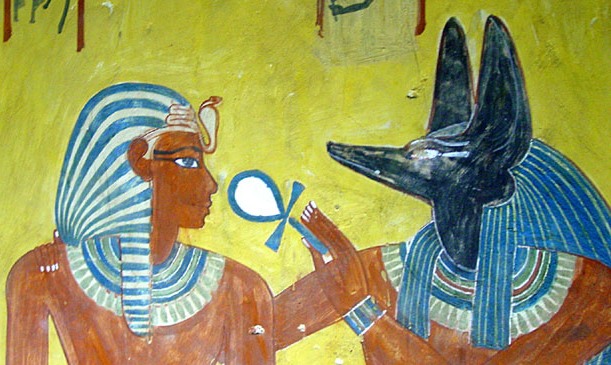
12 Comments

Filed under akhu / ancestors, indigenous, mystic woo-woo, pagan

For Service, Slavery, and Sex : Tattooing in Ancient Egypt and Mesopotamia

An excellent piece by Sarduríur Freydís Sverresdatter and definitely well worth the read. The subject of tattooing in Ancient Egypt. From slaves to Gods Wives of Amun, tattooing had special significance for certain sectors of society in the Two Lands.

For Service, Slavery, and Sex : Tattooing in Ancient Egypt and Mesopotamia.

1 Comment

Filed under akhu / ancestors, herbs, kemetic, reblogged