Category Archives: kemetic

D is for Djed

Djed Pillar

Djed Pillar as found in the Tomb of Nefertari, Valley of the Queens

The Djed Pillar or Djed Column is representative of the idea of stability. The Djed pillar comes from as early as Pre-Dynastic times. Some Egyptologists believe it was a pillar that grain was once tied to and this symbol was associated with Ptah and Sokar and then later with Wasir (Osiris). Ptah of the Triad of Mennefer (Memphis) was often referred to as “The Great Djed”. It is because of the association with Sokar and the mummiform figure of Ptah, that the Djed is associated with Wasir. Some illustrations that have been found on papyri and tomb walls show the Djed with arms and a crook and flail – indicated Wasir’s resurrected state in the Duat (Underworld).
Ptah

Ptah

The ceremony of the ‘Raising the Djed Pillar took place in the city of Menefer or Memphis. The King, aided by the priests, would raise the pillar with ropes. A Djed lying on the ground is indicative of death, and the raising of the Djed is symbolic for raising up or bringing new life. Because the Pharaoh was the ruler of the living and Wasir was the king of the dead, the act of raising the Djed was believed to emphasize both the stability of the King and with him, the land, but also tied the king and the land with the rebirth of life in both the world of form and the Duat. Raising the Djed pillar was also done during the Heb-Sed festival which was performed by the Pharaoh to reaffirm his strength and endurance at year 30 and then every three years again after this. It was considered a joyous occassion.

It was a common practice to paint an image of the Djed pillar in the back interior panel of coffin for the obvious reference of the symbol representing the backbone and would be in the precise place where the actual backbone of the deceased would rest. The stabilizing and regenerative meaning of this is obvious. Djed amulets were also commonly included in the wrappings of mummies to insure the renewed life of the deceased in the Duat. On these amulets were sometimes inscriptions of prayers or heka. A portion of the Prt Em Hru or Book of the Dead were engraved on one of two Djed amulets that were found on the mummy of Tutankhamen. The word words to be recited to the god Wasir (Osiris) were:

“Thou hast thy backbone, O weary one of heart; thou shalt place thyself upon thy side so that I may give thee water beneath thee. I have brought thee a djed pillar of gold; mayest thou be pleased with it.”

Nefertari offering to Ptah

Nefertari offering to Ptah

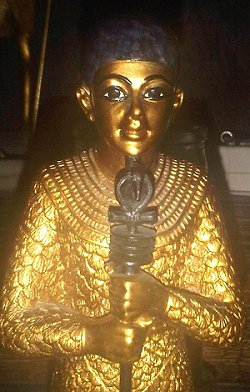
In the tomb of Queen Nefertari in the Valley of the Queens in Egypt, Nefertari is shown offering to Ptah who is standing in a kind of kiosk. Directly in back of him is the Djed pillar and even the staff that the god holds is in the form of the Djed. One of the inscriptions include the Djed, the Ankh and the Was and says:

“All protection, life, stability, dominion and health are behind him.”

In Kemetic belief, the four capitals at the top of the Djed pillar signify stability. Everything, for us, is almost always done in fours – the four corners of a building, the four times that we declare purity, “It is pure, It is pure, it is pure, it is pure,” or the four times we encircle a room with natron and water, light and incense and sound – all lend itself to establishing a foundation of purity, and again, tie back to the Djed and its manifold symbolism. Stability allows firmness of purpose, to know where we stand, or that what has been established can be carried on and continued on that firm foundation of stability.

Resources

Naydler, Jeremy. Temple of the Cosmos: The Ancient Egyptian Experience of the Sacred. Rochester, VT: Inner Traditions, 1996. Print.

Naydler, Jeremy. Shamanic Wisdom in the Pyramid Texts: The Mystical Tradition of Ancient Egypt. Rochester, VT: Inner Traditions, 2005. Print.

Shaw, Ian, and Paul T. Nicholson. The Dictionary of Ancient Egypt. New York: Harry N. Abrams, 1995. Print.

Wilkinson, Richard H. Reading Egyptian Art: A Hieroglyphic Guide to Ancient Egyptian Painting and Sculpture., p.176 – 177; London: Thames and Hudson, 1992

PBP2014d

1 Comment

Filed under kemetic, pagan, Pagan Blog Project 2014

C is for Celestial Cow

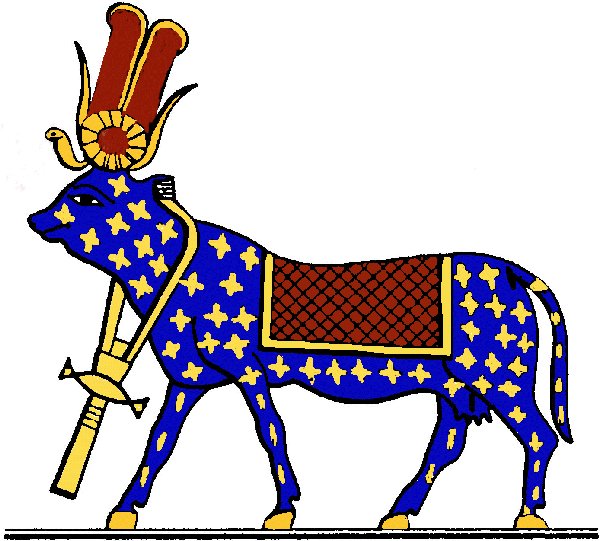
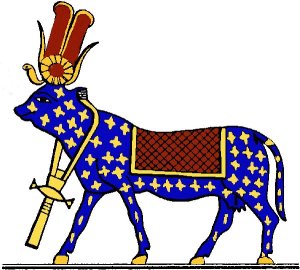
moocowOne of the most enduring symbols of Deity in the Ancient Egyptian cosmogony is that of a Bovine Goddess. From the earliest dynastic period and the Narmer Palette with the figure of the goddess Bat, believed to be a precursor to the popular HetHert – more commonly known as Hathor, the imagery of a celestial or divine cow has endured. Though Aset (Isis) and Hathor both are commonly shown with horns and a solar disk as part of their symbolism, only Hathor has bovine ears.

The Book of the Heavenly Cow, though some believe it originated during the Amarna period under Amunhotep IV (Akhenaten) more likely actually originated around the time of Amunhotep II, Akhenaten’s paternal great grandfather. This is most likely because of an illustration on the walls of his tomb which depicts the pharaoh suckling from the Great Divine Cow. the story is also depicted on the golden shrines that were found within the tomb of King Tutankhamun. Cows appearing in both the sky and in the Duat (Underworld) linked Hathor and Nut as being the one who bore the sun god, Ra, upon Her back. The story of the Celestial Cow appearing in the tomb has less to do with the magical transformation or protection of the King as the tale is probably meant a Creation tale. The Book of the Divine Cow or Celestial Cow ties directly to the mythos surrounding Sekhmet and the Destruction of Mankind.

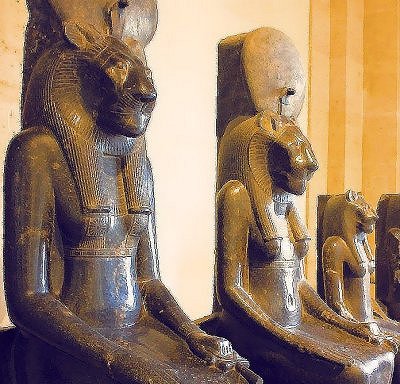
I have talked a little about this in other blog posts. This story has direct correlations also, with the Flood of Noah in the Christian bible where Mankind, in its rebelliousness has turned their faces from Divine authority. In the Egyptian version, Mankind not only turned away, but in some versions, plotted to overthrow and kill the Netjeru (Gods). Ra asked the others what to do, and they asked Ra, Who was their King, to send His ‘Eye’. The Eye, in this tale, is HetHert (Hathor) and in Her rage, She transforms from Her more benign form of a beautiful woman with bovine ears into the lioness, Sekhmet.

Before all of this had transpired, there had been a golden age upon the earth where Mankind and the Netjeru had lived side by side under the rulership of Ra. In that golden age, there was no death, there was no real delineation between day and night where Ra traversed across the sky and then into the Underworld at night. He was always visible at all times. All of this was before the accidental creation of the Uncreated One [Apep ] or any knowledge or concept of isfet.

When Ra sought the counsel of the other deities, He asked them to tell him what to do, that he did not want to wipe humanity out, but rather to punish them. He asked Nu, who said, “Send forth Thine Eye (HetHert) to strike those who blaspheme you, for none may resist the Eye when it shines in the form of HetHert.”

When HetHert was summoned, She became very angry at those who would raise their hand against Ra, Her father. She transformed into Sekhmet and for a period of three days and three nights, she indiscriminately slew every human that she came upon; men, women and even children where She found them. Her slaughter began at Hensu (Herakleopolis Magna) and continued throughout the land. Ra was alarmed at the bloodshed and He implored Sekhmet / HetHert to stop her killing. She looked upon Her Father and flatly refused. By this time, the anger that She was feasting on had become a heady draught of its own. “As sure as You live for Me (By all that is holy),” She said, “so it is pleasing (a balm upon My heart) to have triumphed over them (Mankind).”

Ra was concerned that Sekhmet would slay all of humanity until there were none left. He needed a plan to stop Sekhmet / HetHert from destroying humans entirely. It was Djehuty (Thoth) who came up with the idea of taking red beer, spiking it with mandrake and colouring it with red ochre or hematite in order that it should resemble blood. He did this with the assistance of slave girls or priestesses of the Goddess. Vats and vats of this soporific liquid was poured out onto the land until it resembled a vast lake of blood placed directly in the path of the raging Goddess. Sekhmet came upon this lake of red beer and began to drink. She drank and drank until She became happy and forgot about why She was angry in the first place and was at last quelled, turning once again back into the beautiful (if not happily drunken) Hethert. From time immemorial during the feast that commemorated the pacifying of Sekhmet / Hathor, making the beer was entrusted to the priestesses or slave girls to make the intoxicating drink that was consumed.

Celestial Cow Inscription Ra and the rest of the Gods were overjoyed that Sekhmet’s carnage had at last stopped. Ra cried out in joy at seeing HetHert again, “Welcome, welcome in peace, O’ Beautiful One!”

But at this point, Ra withdraws from the Earth, from Mankind, not as a form of punishment but rather because He realized that unleashing His rage, in the form of Sekhmet, He introduced to the world, the reality of death and destruction for the very first time. The Golden Age that knew Mankind and Gods to live as One in the same place upon the Earth is now over. Ra knows deep down that in order save humanity from the potential of His wrath, there needed to be distance between Hims and the creation (Humanity) that He loves.

The Eye of Ra, Who was a lioness, now being pacified has transformed back into a cow. This cow is called mehet-weret ‘Great Flood’ or “Great of Flood”, which is also equated with Nut, the starry sky at night as well as with HetHert. The ‘Great Flood’ was made of beer, rather than of water. The “flood” within Egyptian mythology ends up being Mankind’s salvation when it came, rather than that which was sent to cleanse the earth of humanity. Mehet Weret / Nut allows Her Father, Ra, to ride upon Her back into the sky and the Two begin to ascend.

In the myths that make up the Book of the Divine Cow, several times She (HetHert / Nut) becomes fearful of the heights to which She and Her Father, Ra, have risen. Her Father urges Her to continue to climb, encouraging Her along the way as They keep rising up higher and higher into the sky. At one point, She becomes so frightened that She cannot stand on Her own. Ra summons the sons of Shu, who are referred to as “the pillars that hold up the sky” and the four winds so that They can steady Nut by holding onto Her legs so that She will, shoring Her up so that She will not fall.

At last Ra and Nut and Their entire accompaniment reach Their lofty destination. The Cow, for Herself, becomes quite lonely for all that She and Ra have left behind Them. Ra reassures her by reminding Her that all over Her body are the stars that make up the nighttime sky. Her starry raiment serves as a sentimental glimpse and a memory of all of those good people and things that are now removed from the world by death that may seem now to be gone. They are, in fact, not gone at all, but are always there. Today, like many cultures, Kemetics look up at the starry night sky and see the millions upon millions of akhu or ancestors who are there. Like Ra, they are removed from us but not truly gone. There is a comfort to know that our akhu are never far away and they are between us and the Divine. They keep the Gods company and the serve as a go between to intercede on our behalf and vice versa.

I love the way that Rev. Tamara Siuda explained it that, “In creating the Celestial Cow, Ra has both made sure that She will never be lonely – and righted the wrong of killing people in the first place, by making sure that they can have another life after the lives they lost, and another chance at redemption.”

The takeaway from the lesson of the Celestial Cow is that no matter how bad things may seem, no matter how far from redemption things may appear, we are never alone. Even though it may feel as if we are facing a crisis or the world at large completely with no one to hear or to help, we have many things around us in terms of people, nature, the celestial sky and even our memories to keep us company. They are there to bolster us and back us up whenever the needs arise. The blinking stars in the sky at night are that reassurance that someone, in fact several someones are up there and are indeed listening.

Resources

Piankoff, Alexandre, and N. Rambova. The Shrines of Tut-ankh-amon. New York: Harper & Row, 1962. Print.

Roberts, Alison. Hathor Rising: The Power of the Goddess in Ancient Egypt. Rochester, VT: Inner Traditions International, 1997

Roberts, Alison. Golden Shrine, Goddess Queen: Egypt’s Anointing Mysteries. Rottingdean, East Sussex: NorthGate, 2008.

Roberts, Alison. My Heart My Mother: Death and Rebirth in Ancient Egypt. Rottingdean, East Sussex: NorthGate, 2000.

Shaw, Ian, and Paul T. Nicholson.The Dictionary of Ancient Egypt. New York: Harry N. Abrams, 1995.

Siuda, Tamara L. The Neteru of Kemet: An Introduction. New York: : Eschaton Productions, 1997.

Siuda, Tamara L. The Ancient Egyptian Prayer Book. Chicago, IL: Star Gazer Design, 2009.

Siuda, Tamara L. “Kemet Today: And There Were Stars: How a time out turned into a nighttime sky”

PBP2014d

3 Comments

Filed under kemetic, pagan, Pagan Blog Project 2014, sekhmet

ENOUGH!

Africa191There is no shortage of people in the world, and especially online who want to worship or honour the Kemetic (Egyptian) gods or Netjeru. You would think after 20+ years of Kemetics being online they would have tried to build alliances and make bridges without the petty infighting and holier than thou bullshit that gets handed around like last year’s Christmas fruitcake.

Let me state at the outset before I say anything else, that I have no grand vision of being “in charge of” anything. I am not here to take anyone to task or to fight with anyone else. This is not some half-arsed attempt on my part in order to get students or for me to become a guru of some sort. I am flat-out not interested in such things at all. Been there, done that, and I donated the T-shirt because it wasn’t “me” anymore. I’m just like everyone else in that I am committed to the culture, the history and the religous ideals of Ancient Kemet. I am not an accredited Egyptologist. I fully acknowledge that I am here by the grace of Sekhmet and the generosity of many, many talented sebau (teachers) and to them I am eternally grateful and I refuse to dish or diss on any one of them.

Lately I have noticed increasing factionalisastion going on within the Kemetic landscape. In the years that I have been blissfully far removed from the jealous infighting, the petty backbiting, hubris and ‘witch wars’ that seem to be part and parcel of the so-called Pagan “community”, I have watched those traits migrate here. After 20+ years, I am exhausted.

So, that being said, I am going to do everything in my power to establish a list of various Temples, Shrines, blogs, organizations, information resources, etc. because it is absolutely needed. If anyone thinks I am doing this for any specific organization, guess again. I’m not. Sekhmet has given me marching orders 1) finish the book and 2) establish the network because honestly, the Pagan Community and the Kemetic Community in specifics deserve at least a modicum of respect, in spite of the differences between us and it’s time that this happened. It is long past time, to be honest. This should have been done some 20 years ago, but for whatever petty, ego-driven, any other set of reasons, it did not transpire. It’s going to happen NOW.

We are bigger than this. We should not (still) have to be listening to the petty, catty, bitchy, in-fighting that goes on for no good reason. There are no good reasons why we cannot do this. If I have to kick ass, or become some sort of pariah, ostracized or called out for being a Kumayah, Pollyanna Kemetic, so fucking be it! We are long past done playing at this. It’s time to do it.

Still have doubts? Let me spell it out:

It’s about, GOD, or the Gods (plural) and our relationship to them, people!! Get OVER it! We all have something to contribute and we NEED to be doing that in the interests of Ma’at. I am not interested in hearing the arguments against such a thing moving forward. I will not give credence to he said / she said, petty grudges from years ago that happened on Usenet, Ancient Worlds, or Tumblr. There are no more excuses, so don’t bother bringing them up to me. It’s time for all of us to ask ourselves, each and every one: “WHY the fuck are you here?!” We collectively need to take what I call the Janet Jackson Approach and ask ourselves, ‘What have YOU actually DONE for the God(s) lately?! What have you done for yourself lately?!” After answering those questions honestly, the next question to ask must be, “What’s stopping you? Who do you think is preventing you from doing it?” If we fall into the temptation to start to point fingers at anyone else than the man or woman that is in the mirror, then I encourage each of us to remember that with that pointing of fingers, there are still three other fingers and a thumb pointing right back at us.

I will write this up in more detail in a bit, however, if anyone imagines that I am doing this to step on toes or encroach on their “territory”, they need to take a step back. This is solely about trying to take a cursory census of who thinks the idea of a collective of those who are bound by the things that we believe and hold dear is more important than the ongoing factionalization that we have been suffering from for over 20 years.

Playtime is over. It’s time to STFU and get to work. If you want it, well then each of us needs to determine just how much and what we are willing to do in order to achieve it.

Excuses are boring. Let’s get to it.

2 Comments

Filed under kemetic, mystic woo-woo, pagan, politics, private, rants, sekhmet, update, writing

Truths Are Truths: Offering ‘Enough’

Nefertari offering to Hathor, from the tomb of Nefertari, Valley of the Queens

Nefertari offering to Hathor, from the tomb of Nefertari, Valley of the Queens

So often we hear of giving an adequate sacrifice to our gods. Certainly, some pagans, do manage to generously give either to their respective religious organizations or favourite charities, but there is that bit of offerings and giving that we all tend to do privately.

Recently there was a bit of a flap concerning some very ill-considered commentary about what is adequate or enough in terms of offerings made toward deities. Certainly there are cultural considerations that should be taken into account, depending on what Gods you are worshiping. In the case of some specific gods, to partake of the things that you offer to Deity is considered ‘stealing’. While in the case of ancient Egyptian or Kemetic gods, partaking of the offerings after the reversion is said over them is considered customary and proper. To waste food or to not share it with the greater community is considered to be the height of foolishness. If the gods give us their bounty, what better way to exemplify this than to communally spread the wealth and feed those who are assembled in celebration?

It is an unfortunate fact that I have heard time and again about how what is being offered is not considered “appropriate” or “good enough” for deity. Neither poverty nor ability to give more can be considered an adequate excuse. If you are not giving a juice box, to cite one of the examples, poured out as a libation to the gods, then by golly, you are doing it wrong. Others underscore the idea that somehow our focus and insistence on doing it right gives license for some to cop a sense of arrogant exclusivity and a holier-than-thou haughtiness that is neither attractive nor impressive to many of us who have been at this for any length of time.

The reality is that we live in an era that has a real disparity between those who have and those who don’t. Folks who are struggling are worried about whether or not they are going to make it. They live paycheck to paycheck, praying to whatever powers that be that their jobs are not outsourced, or that the unemployment might be extended just a little longer. They fret over whether or not the government is going to give them just enough of a subsidy to feed themselves and/or their families. Offerings to the deities that we worship are a nice idea, but it is little comfort to the mother who knows how damn much those juice boxes or other foodstuffs cost in the greater scheme of things. The idea of letting a child go hungry or thirsty while that asset is offered up to heaven not to be partaken of by the living is a luxury that some just cannot afford. The arrogant ones self-righteously raise their noses higher in the air and sniff disdainfully, “Well, if you can’t afford it, then don’t even bother!”

Where I come from, something so small as cool water, or oil for the limbs, a bit of honey, or a song or a piece of artwork made by our own hands given into the service of Netjer is something that is considered ‘enough’. To devote what one has and what can do out of a giving heart is worth more than expensive works or products lain at the altar. In Luke 20:45-21:4, Jesus warns about teachers of the law, those who would focus on the smallest Nth degree that everything is done according to the law. The Pharisees would pray loudly in the streets and make sure that all witnessed their pious giving and yet a woman who was a widow gave but two copper coins – which was probably the major portion of what she had to live on, gave them at the altar. Back in those days, it was the least in terms of the legal limit that could be offered at the Temple. Jesus noted to his disciples that the rich gave from their vast wealth and did not feel the true spirit of the gift, whereas the woman gave all that she had.

There are those within the pagan community whom others look to as being the arbiters of wisdom and how to do things properly when in service to the gods. Some of them might even have a series of letters after their name that denote impressive degrees that show that they had the money and the time to go back to school. For some within the Pagan community, that may make them bigger and badder than the rest of we who are garden variety devotees and worshipers. (I personally think that is a load of it, but hey, what do I know?)

The undeniable truth is this: We all feel a call and a pull to the Divine, but sometimes we have to be very careful about whom we turn to for advice when it comes to the sincere practices of performing acts of faith. Some, no matter how many letters after their names or tenured positions that guarantee a regular paycheck whilst they sit in the hallowed halls of academia, are full of themselves – and other more ‘fragrant’ substances that sticks to the bottom of shoes. Just because they have an M and an A or a P, an h, and a D after their name doesn’t mean that their offerings will be better received than those of the person who has put their heart and soul into a piece of handiwork – or had just under a dollar to buy a purified bottle of water to offer to their Deity of choice. For those of us who worship gods that were native to lands located in deserts, water was and is still considered a precious sacrifice because there was so very little of it.

The Pagan community in some places tends to be both cliquish and competitive, if not downright cruel at times. It seems as if some make it a point to look over the shoulders of others, to check and see if the offerings made, the devotions said and the form of worship rendered is somehow ‘good enough’. They take great pains to make sure that people not only are doing it well enough according to their standards, but will discuss it loudly across every form of social media available. Certainly such behaviour is not unlike that of the Pharisees who want you to know how very pious, generous and correct they are and how everyone else should be paying attention to how they are doing it.

The Ones who are paying attention, however, are the Ones before whose altars, shrines and temple spaces we lay the offerings before. Those are the Ones we are doing it all for anyway – and maybe a little bi for ourselves, too. That, I believe, should always be considered ‘enough’. It’s that idea along with the inner knowing that we are all enough, that we love enough and that the Divine can and does understand our circumstances and does not judge us for it in ways that others and even we each have a tendency to do. It is this idea which we should be paying attention and listening to rather than the talking heads, of which there seems to be ever an overabundance of.

xtile

5 Comments

Filed under Kemet is Cool Project, kemetic, pagan, politics

Guilt by Association

The adage that we are known by the company we keep probably is very true within the Kemetic Community – perhaps even doubly so. It has become frustrating and disheartening to be judged by people whom you don’t know, who don’t know you, or your specific religious path – nor do they care really! For someone to offhandedly decide that you are not with the “in crowd” or that somehow, will pronounce that not to be of a certain religious affiliation, or sect will deem you unworthy to be given the time of day. Some of course, fear recruitment or being indoctrinated into some sort of cult based on internet rumours that they may or may not have heard.

metmuseum5a1I am Kemetic. I was trained and ordained as a Kemetic Orthodox Priestess of Sekhmet/HetHert in 1998. I stepped down a couple of years ago by choice, or as one internet website geared toward atheists said, “I retired.” I kind of laugh at that. One does *not* retire from Sekhmet’s service. Your service may change, but it is absolutely for life! At any rate, my reasons, initially, were because I was attending college full time and could not give the level of service required. My situation has changed a bit, and so now my reasons of not wanting to return to it again are deeply personal. I can and will say quite clearly that it was not because of any rift with the Temple, or disagreement between myself and any of the membership. I have been listening to Sekhmet’s call and it has been specific and in a direction by necessity. That doesn’t make anyone bad or wrong. It just makes it a different route that I have chosen to take.

All of us must by necessity approach our spiritual life on a personal level. We may choose to join or Initiate in a specific sect, temple or path, but ultimately, only we as individuals can decide when to move on. Each of us, who are Kemetic, have personal rites. Sometimes this entails a daily practice that follows a formal outlined structure, such as that which is outlined at the Temple of Horus at Edfu. While at other times a practitioner may choose something more fluid, eclectic or non-traditional. Each is a valid structure and approach to the connection to the Netjeru.

That being said, the only things that become annoying are those who insist on the belief of either a maddeningly absurd UPG-type of approach, or those who cannot and will not move outside the formal scholarly sanctioned type of practice. I have found by direct experience that there are deep pitfalls within each extreme and either can be deleterious for spiritual understanding or growth. Egyptology does *not* know everything. Conversely, I have seen so many ridiculous, crackpot theories that should never have made it outside of one’s own personal headspace, let alone made it into print for others to try to decipher.

One extreme, that of the scholarly community only, and especially within Egyptology’s ranks, often eschews and ostracizes those who “actually believe in any of this stuff”. In some place it becomes so much of an issue that those who have made it into those hallowed halls of the scholarly ranks take great pains to either conceal, downplay or flat-out deny that they actually do worship the old gods. These individuals dare not speak of it or it may cost them their entire career or get them passed over for any future projects because their beliefs are not considered “objective enough”. I personally know of several tenured professors or professional Egyptologists who by necessity are very guarded about their personal beliefs. I can state quite clearly that their fears are absolutely justified. Egyptology is neither easy nor cheap to take up as a scholarly pursuit. Admissions into these programmes are prohibitively expensive and generally only accept a tiny handful of students each semester or once a year. Most of these who are accepted have and/or have maintained a 4.0 GPA. Further, that high GPA must be maintained or that student will get a boot planted in their posterior and find themselves completely washed out and with student loan amounts that are nothing less than nightmarish and just shy of the national debt.

The Kemetic Community, I think, is going through something that much of the so-called Pagan “Community” is going through. I believe that there is far too much backbiting, petty, catty and deeply personal bitching among the ranks. People either are wrapped up in an idea that if you do not belong to X group, you obviously are “doing it wrong”, and if you are a part of that group – or have been trained by it, have handed your brain, your soul and your personal assets to some sort of mindless cult of personality that does not allow for personal considerations.

I call “Bullshit,” on both points of view.

Even with my training and years in the priesthood, I interact with those who are not Kemetic Orthodox. I spend a great deal of time with people who come from many different faiths and belief systems, and each gives me a perspective that I would not have had otherwise. In so doing, I am able to form my own opinion that has nothing to do with toeing a party line, a religious canon or being a spokesperson for any given temple or group.

If I see a person make an incorrect, ill-considered or socially repugnant statement to the general public, I have no compunction but to call them on it and tell them why I feel that way. Conversely, I expect to be accorded the exact same service be done to me in return. I also expect that it will be done without the need to resort to ad hominem attacks. I think that is more than fair. Of course, there will always be those who claim to be holier-than-thou, or claim some sort immunity because of the number of books they wrote, lectures at Pantheacon they conducted or letters after their names in terms of university degrees. The political correctness and personal butthurt needs to be put away and replaced with something that resembles common sense. If we cannot have that, then what’s the point, really?

Ma'at from the Tomb of Seti I, at the Museo Archeologica, Turin, Italy

Ma’at from the Tomb of Seti I, at the Museo Archeologica, Turin, Italy

All of us who consider ourselves to be Kemetic have a single and solitary foundation. That foundation is not exclusive to any one group, or leader or anything else. We have nothing other to worry about than the idea of Ma’at. Each of us must decide what that is and where we are at personally. Under that one single idea / ideal, there is enough there that is complex enough to keep all of us occupied for the whole of our personal and spiritual lives. We are held responsible and we hold those whom we associate responsible as well. When we do this, we are held responsible for our own actions and words in the context of not only our own lives but the greater whole within the Kemetic community and within the world at large. With this single understanding, some of the petty, single-mindedness is stripped away, and we by necessity have to sit down and listen to the thoughts, concerns and observations of others. Being able to see that perspective and say, “Yes, you are right,” does not, therefore, declare us to be lepers within the groups that we are a part of – or not a member of. It means that we can each be viable on our own, and that we can stand up for ourselves and what we believe, rather than hiding behind an organization, a label or anything else than our own sense of rightness – or our own sense of Ma’at.

4 Comments

Filed under kemetic, mystic woo-woo, pagan, sekhmet

A is for Ankh

ankh-nose.jpg w=300&h=179The ankh is one of the most widely recognized religious symbols in the world. Ask anyone what the ankh means, and invariably, the words, “eternal life” will be the definition that is offered even by laypersons.

In terms of the hieroglyphic catalogue or sign list that was put together by Sir Alan Gardiner, lists the ankh as Gardiner sign S 34. Scholars have speculated that it can either represent something as simple as a sandal strap, or as complex as an elaborate bow or knot that carried specific religious significance. The profusion if its use in iconography throughout Egyptian culture and that it is held by numerous ancient Egyptian deities in their various depictions underscores the meaning ascribed to the ankh – the meaning is life. Even those who could not read or wriite, and in Ancient Kemet, the literacy rate among its people was something like 2% or 3%, the meaning of the ankh was known. It was commonly found as a potter’s mark on vessels throughout the history of Egypt. (Shaw)

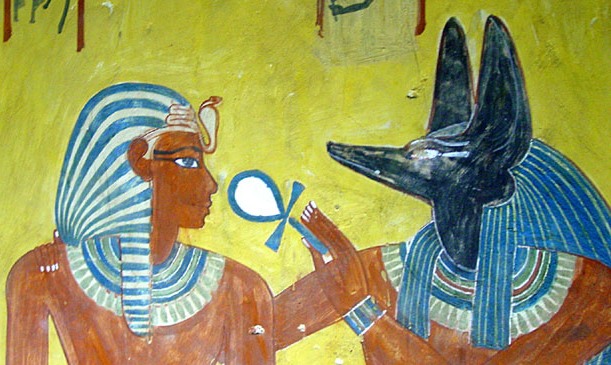
Even today, we often hear the ankh referred to as the Key of Life. More than this, it stands for several life-sustaining things. In some reliefs, ankhs are seen pouring out, to symbolize water and in turn purification. Other reliefs show the sustenance in the form of food or flower offerings which were referred to as ankhu. Most often, however, it is shown to represent the breath of life. Often statuary, paintings or reliefs will show a King, a Queen or other member of the noble class being presented with an ankh that is held beneath their nose by the god or goddess.

From the Tomb of Huya, Amarna Period, Courtesy of Wikimedia Commons

From the Tomb of Huya, Amarna Period, Courtesy of Wikimedia Commons

During the reign of the Heretic Pharaoh, Amunhotep IV, otherwise known as Akhenaten, reliefs of the Aten disk can be seen with streams that form long arms and hands that offer ankhs to the Akhenaten, Nefertiti and their children. During this period, the literal disk of the sun, or the Aten is what gave life to the Two Lands.

Ankh mirror case

Mirror case from the tomb of Tutankhamun

Most everyone also knows that the word ankh can also mean mirror and often mirrors in ancient Egypt were made in the shape of an ankh.

The idea that a Temple was called a Per Ankh or ‘House of Life’ did not just mean simply it was a place of worship, but also learning how to live, via the Netjeru and that Rameses IV claimed that he had studied the papyri at the House of Life to learn the secrets of the gods. Living one’s life is an active thing and so we can only surmise that the training that the King underwent was experiential and the secrets he learned were not just intellectual in nature. (Naydler)

The ankh survives today, not just among Kemetics and Pagans who incorporate the symbol into their personal practices, but even after the fall of Ancient Egypt to Roman Rule and Roman Paganism, the natives of Egypt among the first to convert to Christianity, but the ankh survives in the form of the crux ansata, ansate, looped, or handle-shaped cross in the Coptic Church.

Resources

Naydler, Jeremy. Temple of the Cosmos: The Ancient Egyptian Experience of the Sacred. Rochester, VT: Inner Traditions, 1996. Print.

Naydler, Jeremy. Shamanic Wisdom in the Pyramid Texts: The Mystical Tradition of Ancient Egypt. Rochester, VT: Inner Traditions, 2005. Print.

Shaw, Ian, and Paul T. Nicholson. The Dictionary of Ancient Egypt. New York: Harry N. Abrams, 1995. Print.

Wilkinson, Richard H. Reading Egyptian Art: A Hieroglyphic Guide to Ancient Egyptian Painting and Sculpture., p.176 – 177; London: Thames and Hudson, 1992

PBP2014d

9 Comments

Filed under kemetic, pagan, Pagan Blog Project 2014

Sekhem Talisman Day #3

My Sekhem pendant is about about the size of a set of dog tags; which makes it only slightly smaller than a license plate! Don’t get me wrong; I absolutely love it! Aidan made a beautiful piece that I wear daily, and happily so. It is the one that he made that I have posted pictures of in earlier entries rather than the one that I am working with for this 30 day challenge project. The current sekhem pendant is the second one that I have commissioned from a silversmith that was made to my own specifications.

The first pendant, by contrast, is very delicate and is a 3D miniature of the actual object rather than the glyph inside a cartouche.

sekhem pendant #1

Sekhem Pendant made by Michael Holland

The problem is, right now, that particular piece has got a very distinct stress point where the baton portion of the scepter meets the lutus-shaped base of the sekhem flabellum and the slightest pressure on it will cause it to bend. I know that it would break if I were to dare to wear it before it is fixed. Ultimately, it was damaged because I very stupidly slept with it on for the entire summer. Most jewelry isn’t meant for that kind of abuse – especially not fine, highly pure silver that has very slender parts to begin with! So, now I have to send it to a place that specializes in a sort of laser repair. There is one “locally.” eg. somewhere here in Iowa, but I am more inclined to send it back to the silversmith in Montana, Michael Holland, whom I originally commissioned it from to see what he can do.

This little dilemma between the two Sekhem’s actually got me to thinking about subtle power and not so subtle power and the comfort levels of each. Subtle power is not so noticible whereas, overt power tends to be out there and often get attention. As such, it can make the wielder of that more overt type of power at times feel a bit self-conscious about it. Learning how to deal with that difference can be a bit of a task. Sometimes, speaking from experience, being the less overt bit of power behind something has its advantages because there is great power, great sekhem in being underestimated. Either one has its place and it’s that which was my focus on this day.

2 Comments

Filed under 30 Day Talisman Challenge, kemetic, pagan, sekhmet

Sekhem Talisman – Day #2

Nefertari making offerings

Nefertari from her tomb in the Valley of the Queens, Egypt

Yesterday marked the second day of rituals that I will be performing around the Sekhem amulet / talisman created by Aidan Watcher for the 30 Day Talisman Challenge as posted by Andrieh Vitimus.

The daily rite was performed with the usual purifications and invocations. Because I had an intensely busy day, after the purifications and invocations, I began to set the focus on being what Sekhem means. I spent most of the day meditating on this idea and what the symbol and the actual concept means for me as an individual in my own life and what it means on a larger, global scale. There are far too many ways in which power, both personal and on a larger scale is misused. With power or sekhem comes a great deal of responsibility. Each choice we make, each action we choose has within it the idea of sekhem. Those of us who are Kemetic often know that the cornerstone, indeed the foundation of all of this is the idea of ma’at.

Perhaps the largest focus for me is overcoming the element of fear. That may be something that one would believe that a daughter of Sekhmet would not have but I can assure you, at times we do; just like everyone else!During the meditation it became quite apparent to me that even a seeming weakness, however, can ultimately lead to strength in that area or another one that compensates. Sometimes fear can be a phantom and what is perceived is not real at all. The power or the sekhem in this is knowing what is real, or what is Ma’at and not. Since Sekhmet, the personification of what Sekhem actually is, upholds Ma’at or rightness – order, it seemed more than a little appropriate that differentiation and discernment would be a part of that process.

Later today I will post for Day 3 of the rites in this challenge.

Leave a comment

Filed under 30 Day Talisman Challenge, kemetic, mystic woo-woo, pagan, sekhmet

30 Day Talisman Challenge – Sekhem Talisman – Day 1

Since my practices are Kemetic (Ancient Egyptian), we tend to do our rituals a little differently. I decided to actually start the consecration of the amulet today, as the year turns from 2013 to 2014 and when the Moon is New. For this specific ritual as I do most times, I am working with Sekhmet, who is my Spiritual Mother, and also the God Amun.

My entry into the 30 Day Talisman Challenge is working with a pendant that I did not create, but rather worked with jewelry smith and magician, Aidan Watcher. I helped design the piece and my friend who is an extraordinary craftsman made the pendant is of solid silver. The symbol at the centre of the cartouche is Gardiner Sign S42 and represents a baton or scepter that was in use since the Third Dynasty in Egypt known as the Sekhem. Sekhem is the root word for the Goddess Sekhmet, which literally means ‘Power’ or ‘Might’. Sekhmet is known as ‘She of Might’ or ‘The Powerful One’.

The first part of the ritual consecration begins as all Kemetic rituals do – first with purification of the body and of the mouth with water and natron so that the words of power or heka when spoken are also true coming from a mouth and a person who has been suitably and ritually purified. Then is added light, incense and sound.

Each day that I do the rite, there will be heka spoken over the Sekhem pendant will underscore the authority that it as a symbol confers. The amulet is worn during that day, meditating on each point during the course of the day, At night the amulet is removed and left in the shrine with icons of the Goddess Sekhmet, an icon of the God Amun, and a third icon of the Goddess Ma’at. Each have specific significance to the rite and are instrumental in the consecration rites. A 7 day candle burns before the shrine at night, while during the day wen the amulet is worn and the sun is shining, the shrine doors are closed.naos1a

1 Comment

Filed under 30 Day Talisman Challenge, kemetic, mystic woo-woo, pagan

The Kemet is Cool Project

pendant In my travels, being fresh from bed and my 30 second commute to my office, I was thinking that the prevailing theme here on my blog, on Tumblr and on my Facebook page is all about Kemet. All in all, I find that it doesn’t really matter what anyone’s individual opinion on Kemet is. For all of us, its the art, the religion, the culture and the history are truly what draw us. What matters to the most people is just that we are drawn to it – the why sometimes is rather intangible. There is a simple, yet sophisticated beauty that is timeless and it is that which speaks to the deepest part of our individual psyches.

So, that focus is going to be reflected here on my blog at fannyfae.com and on my Facebook page (as usual). It seems to be what people most resonate to, and it gives me a chance to show others with the same love of Kemet or Ancient Egypt things they may not have heard of, aritists they may not be aware of that do fantastic work.

I look at this as my effort to get away from the infighting and the petty squabbles that seem to plague so many groups. I don’t care if the resource is Kemetic Orthodox, Reconstructionist, Afrocentrist, mainstream Egyptology or what have you. One truth remains: We each love the Two Lands for our own reasons, and no one else can dictate those reasons to us except by the callings of the deepest place in our kas. This project is specifically about that and that alone with no other agenda.

Ankh, udja seneb! (Life, prosperity and health!)

Fanny Fae (aka NiankhSekhmet)

1 Comment

Filed under kemetic, pagan