
My friend Sarduriur has written of the most thorough discussions on the concept of what heka is and what it isn’t. Grab a cup of coffe, sit back and enjoy a nice long read.
B is for Bennu Bird

Bennu Bird by Jeff Dahl, courtesy of Wikimedia Commons
“I am that Great Phoenix which is in Iunu/Heliopolis
I am the one who assigns what exists.
What does it mean?
It is Eternity and Perpetuity
As for Eternity (cyclical time), it is the Day
As for Perpetuity (linear time), it is the Night” – (from Spell XVII, “Prt Em Hrw” the “Book of Coming Forth by Day” or “Ancient Egyptian Book of the Dead”, R.O. Faulkner Translation)
The Bennu Bird is the predecessor of the Phoenix of Greek mythology. This symbolic representative of Creation is tied to the word weben, which means ‘To Rise’. The Bennu or Benu Bird is tied to the gods Atum, Ra and Wasir (Osiris); which would explain this deity being featured wearing an Atef Crown. The Bennu bird ties to the Benben stone which also resided in Heliopolis. Atum, according to legend rose up as the Benben in the Mansion of Benu in Heliopolis. The Benben Stone itself was believed to be constructed of and representative of the solidified semen of Ra-Atum as the Soul of Ra when He copulated with His own hand to Create the rest of the known Universe. Later the Hand was attributed to various goddesses in the Ancient Egyptian pantheon and in the person of the Queen or Hm.t Niswt of the Pharaoh.

A portion of the Book of the Dead of Nakht depicting the Bennu Bird
The Bennu, according to the Metternich Stele, created itself from a fire that burned on the sacred Persea Tree located at Heliopils. It was believed that the Bennu bird would build His nest of twigs made of incense, more specifically, myrrh (Commiphora myrrha) in the Persea tree and die. In Heliopolis, it was also believed that the sun rose of the Bennu to illumine the sky and died five hundred years, the Bennu Bird would fly into Egypt from Arabia, carrying in His beak an egg composed of myrrh , representative of His Father’s body. It is this egg, of the Great Cackler, Geb, that is left on the Primordial Mound. It is on this Mound that the sun, Ra is again reborn.
One of the earliest appearances of the Bennu Bird is in the Pyramid Texts of Unas as a yellow wagtail and then later, in the Book of the Dead, the bird seemed to have changed shape into that of a Gray Heron (Ardea cinera) . These birds are quite prolific here in the Wapsipinicon River Valley and every time I see one in flight or pausing looking for food in the many waterways and tributaries in our forests, it serves as a breathtaking reminder of the Benu bird.

The Bennu Kite that hangs in Userbenu’s room.
Perhaps on an unconscious level when we moved our family from the city out to the wilds when my son was all of six years old, it was the draw of the Great Bennu. It was the Bennu who became a part of my son’s Kemetic name of Userbenu, or the Strength of the Phoenix. No parent wants to consider that their child will experience difficulty, but my son latched onto the imagery of the Phoenix almost as soon as he became aware of it. To this day, a a giant hand-painted kite that we found at New Pioneer Natural Foods Co-op almost 20-odd years ago, hangs on the ceiling of his room. It has, I think served as a reminder for him and for the rest of us the important image of the Bennu Bird.
Such powerful imagery is important for us as humans, even when we are kids. There are few books that really are tailored toward Pagan, or especially Kemetic parents and their children. One of the best books that I have ever seen on the market, and one that I bought for my own son and hope to hand down to any future grandchildren is The Cry of the Benu Bird by C. Shana Greger tells the story of Atum and the Benu Bird in a delightful way. Of course, it does not go into much of the aforementioned more erotic aspects of that Creation Myth, but it does talk about the Creation of the other Netjeru in a way that children can appreciate and understand. It’s beautifully illustrated and gets young minds thinking about the Netjeru and their potential relationship with Them and the rest of the world.
Normandi Ellis put the idea of our eternal rising from the ashes of those parts of lives at every stage. like the Bennu Bird, so beautifully. Her translation of the Ancient Egyptian Book of the Dead has often served as a poignant reminder for us and for those whom we love.
I have entered fire, I become invisible; yet I breathe in the flow of sun, in the eyes of children, in the light that animates the white cliffs at dawn. I am the god in the world in everything, even in darkness. If you have not seen me there, you have not looked. I am the fire that burns in you. To live is to die a thousand deaths, but there is only one fire, one eternity.”
Resources: – Normandi Ellis, Awakening Osiris
This idea of a Self-Created One, is central to Kemetic Religion. The Bennu Bird and the Phoenix have proven to be a powerful symbol or representation of the Divine for many throughout history. and Pagans and Kemetics today. We are each of us born, we live our lives, and we die. But in that life that each of leads there are series of births, lives, deaths and rebirths. None of us has been the same person we were when we started out or even a few years or even months or weeks ago. This is true not only of our personal lives, but our work lives and spiritual lives as well.
Subtly, we understand the process of cycles, of becoming of being and final release. We also, most of us, have various ideas about what comes next, what comes after. Though we may never see too far down the road, we always have that sense of inner knowing, of the cycles always continuing until we, like the Bennu bird, can be reborn once more.
Resources
“Benu-bird (the Phoenix).” Amentet Neferet Egyptian Religion. N.p., n.d. Web. 15 Jan. 2014.
Ellis, Normandi. Awakening Osiris: A New Translation of the Egyptian Book of the Dead. Grand Rapids, MI: Phanes, 1988.
Faulkner, Raymond O., and James P. Allen. The Ancient Egyptian Book of the Dead. New York: Barnes & Noble, 2005.
Shaw, Ian, and Paul T. Nicholson.The Dictionary of Ancient Egypt. New York: Harry N. Abrams, 1995.
Veggi, Athon, and Alison Davidson. The Book of Doors Divination Deck: An Alchemical Oracle from Ancient Egypt. Rochester, VT: Destiny, 1995.
January 19, 2014 · 6:19 pm
Truths Are Truths: Offering ‘Enough’

Nefertari offering to Hathor, from the tomb of Nefertari, Valley of the Queens
Recently there was a bit of a flap concerning some very ill-considered commentary about what is adequate or enough in terms of offerings made toward deities. Certainly there are cultural considerations that should be taken into account, depending on what Gods you are worshiping. In the case of some specific gods, to partake of the things that you offer to Deity is considered ‘stealing’. While in the case of ancient Egyptian or Kemetic gods, partaking of the offerings after the reversion is said over them is considered customary and proper. To waste food or to not share it with the greater community is considered to be the height of foolishness. If the gods give us their bounty, what better way to exemplify this than to communally spread the wealth and feed those who are assembled in celebration?
It is an unfortunate fact that I have heard time and again about how what is being offered is not considered “appropriate” or “good enough” for deity. Neither poverty nor ability to give more can be considered an adequate excuse. If you are not giving a juice box, to cite one of the examples, poured out as a libation to the gods, then by golly, you are doing it wrong. Others underscore the idea that somehow our focus and insistence on doing it right gives license for some to cop a sense of arrogant exclusivity and a holier-than-thou haughtiness that is neither attractive nor impressive to many of us who have been at this for any length of time.
The reality is that we live in an era that has a real disparity between those who have and those who don’t. Folks who are struggling are worried about whether or not they are going to make it. They live paycheck to paycheck, praying to whatever powers that be that their jobs are not outsourced, or that the unemployment might be extended just a little longer. They fret over whether or not the government is going to give them just enough of a subsidy to feed themselves and/or their families. Offerings to the deities that we worship are a nice idea, but it is little comfort to the mother who knows how damn much those juice boxes or other foodstuffs cost in the greater scheme of things. The idea of letting a child go hungry or thirsty while that asset is offered up to heaven not to be partaken of by the living is a luxury that some just cannot afford. The arrogant ones self-righteously raise their noses higher in the air and sniff disdainfully, “Well, if you can’t afford it, then don’t even bother!”
Where I come from, something so small as cool water, or oil for the limbs, a bit of honey, or a song or a piece of artwork made by our own hands given into the service of Netjer is something that is considered ‘enough’. To devote what one has and what can do out of a giving heart is worth more than expensive works or products lain at the altar. In Luke 20:45-21:4, Jesus warns about teachers of the law, those who would focus on the smallest Nth degree that everything is done according to the law. The Pharisees would pray loudly in the streets and make sure that all witnessed their pious giving and yet a woman who was a widow gave but two copper coins – which was probably the major portion of what she had to live on, gave them at the altar. Back in those days, it was the least in terms of the legal limit that could be offered at the Temple. Jesus noted to his disciples that the rich gave from their vast wealth and did not feel the true spirit of the gift, whereas the woman gave all that she had.
There are those within the pagan community whom others look to as being the arbiters of wisdom and how to do things properly when in service to the gods. Some of them might even have a series of letters after their name that denote impressive degrees that show that they had the money and the time to go back to school. For some within the Pagan community, that may make them bigger and badder than the rest of we who are garden variety devotees and worshipers. (I personally think that is a load of it, but hey, what do I know?)
The undeniable truth is this: We all feel a call and a pull to the Divine, but sometimes we have to be very careful about whom we turn to for advice when it comes to the sincere practices of performing acts of faith. Some, no matter how many letters after their names or tenured positions that guarantee a regular paycheck whilst they sit in the hallowed halls of academia, are full of themselves – and other more ‘fragrant’ substances that sticks to the bottom of shoes. Just because they have an M and an A or a P, an h, and a D after their name doesn’t mean that their offerings will be better received than those of the person who has put their heart and soul into a piece of handiwork – or had just under a dollar to buy a purified bottle of water to offer to their Deity of choice. For those of us who worship gods that were native to lands located in deserts, water was and is still considered a precious sacrifice because there was so very little of it.
The Pagan community in some places tends to be both cliquish and competitive, if not downright cruel at times. It seems as if some make it a point to look over the shoulders of others, to check and see if the offerings made, the devotions said and the form of worship rendered is somehow ‘good enough’. They take great pains to make sure that people not only are doing it well enough according to their standards, but will discuss it loudly across every form of social media available. Certainly such behaviour is not unlike that of the Pharisees who want you to know how very pious, generous and correct they are and how everyone else should be paying attention to how they are doing it.
The Ones who are paying attention, however, are the Ones before whose altars, shrines and temple spaces we lay the offerings before. Those are the Ones we are doing it all for anyway – and maybe a little bi for ourselves, too. That, I believe, should always be considered ‘enough’. It’s that idea along with the inner knowing that we are all enough, that we love enough and that the Divine can and does understand our circumstances and does not judge us for it in ways that others and even we each have a tendency to do. It is this idea which we should be paying attention and listening to rather than the talking heads, of which there seems to be ever an overabundance of.

Filed under Kemet is Cool Project, kemetic, pagan, politics
Guilt by Association
The adage that we are known by the company we keep probably is very true within the Kemetic Community – perhaps even doubly so. It has become frustrating and disheartening to be judged by people whom you don’t know, who don’t know you, or your specific religious path – nor do they care really! For someone to offhandedly decide that you are not with the “in crowd” or that somehow, will pronounce that not to be of a certain religious affiliation, or sect will deem you unworthy to be given the time of day. Some of course, fear recruitment or being indoctrinated into some sort of cult based on internet rumours that they may or may not have heard.
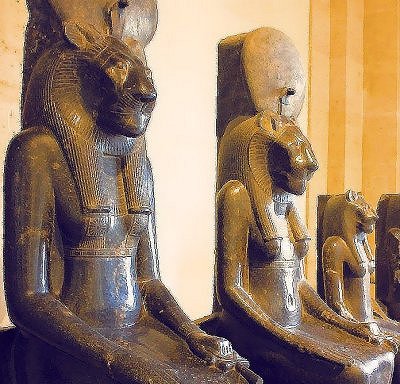 I am Kemetic. I was trained and ordained as a Kemetic Orthodox Priestess of Sekhmet/HetHert in 1998. I stepped down a couple of years ago by choice, or as one internet website geared toward atheists said, “I retired.” I kind of laugh at that. One does *not* retire from Sekhmet’s service. Your service may change, but it is absolutely for life! At any rate, my reasons, initially, were because I was attending college full time and could not give the level of service required. My situation has changed a bit, and so now my reasons of not wanting to return to it again are deeply personal. I can and will say quite clearly that it was not because of any rift with the Temple, or disagreement between myself and any of the membership. I have been listening to Sekhmet’s call and it has been specific and in a direction by necessity. That doesn’t make anyone bad or wrong. It just makes it a different route that I have chosen to take.
All of us must by necessity approach our spiritual life on a personal level. We may choose to join or Initiate in a specific sect, temple or path, but ultimately, only we as individuals can decide when to move on. Each of us, who are Kemetic, have personal rites. Sometimes this entails a daily practice that follows a formal outlined structure, such as that which is outlined at the Temple of Horus at Edfu. While at other times a practitioner may choose something more fluid, eclectic or non-traditional. Each is a valid structure and approach to the connection to the Netjeru.
That being said, the only things that become annoying are those who insist on the belief of either a maddeningly absurd UPG-type of approach, or those who cannot and will not move outside the formal scholarly sanctioned type of practice. I have found by direct experience that there are deep pitfalls within each extreme and either can be deleterious for spiritual understanding or growth. Egyptology does *not* know everything. Conversely, I have seen so many ridiculous, crackpot theories that should never have made it outside of one’s own personal headspace, let alone made it into print for others to try to decipher.
One extreme, that of the scholarly community only, and especially within Egyptology’s ranks, often eschews and ostracizes those who “actually believe in any of this stuff”. In some place it becomes so much of an issue that those who have made it into those hallowed halls of the scholarly ranks take great pains to either conceal, downplay or flat-out deny that they actually do worship the old gods. These individuals dare not speak of it or it may cost them their entire career or get them passed over for any future projects because their beliefs are not considered “objective enough”. I personally know of several tenured professors or professional Egyptologists who by necessity are very guarded about their personal beliefs. I can state quite clearly that their fears are absolutely justified. Egyptology is neither easy nor cheap to take up as a scholarly pursuit. Admissions into these programmes are prohibitively expensive and generally only accept a tiny handful of students each semester or once a year. Most of these who are accepted have and/or have maintained a 4.0 GPA. Further, that high GPA must be maintained or that student will get a boot planted in their posterior and find themselves completely washed out and with student loan amounts that are nothing less than nightmarish and just shy of the national debt.
The Kemetic Community, I think, is going through something that much of the so-called Pagan “Community” is going through. I believe that there is far too much backbiting, petty, catty and deeply personal bitching among the ranks. People either are wrapped up in an idea that if you do not belong to X group, you obviously are “doing it wrong”, and if you are a part of that group – or have been trained by it, have handed your brain, your soul and your personal assets to some sort of mindless cult of personality that does not allow for personal considerations.
I call “Bullshit,” on both points of view.
Even with my training and years in the priesthood, I interact with those who are not Kemetic Orthodox. I spend a great deal of time with people who come from many different faiths and belief systems, and each gives me a perspective that I would not have had otherwise. In so doing, I am able to form my own opinion that has nothing to do with toeing a party line, a religious canon or being a spokesperson for any given temple or group.
If I see a person make an incorrect, ill-considered or socially repugnant statement to the general public, I have no compunction but to call them on it and tell them why I feel that way. Conversely, I expect to be accorded the exact same service be done to me in return. I also expect that it will be done without the need to resort to ad hominem attacks. I think that is more than fair. Of course, there will always be those who claim to be holier-than-thou, or claim some sort immunity because of the number of books they wrote, lectures at Pantheacon they conducted or letters after their names in terms of university degrees. The political correctness and personal butthurt needs to be put away and replaced with something that resembles common sense. If we cannot have that, then what’s the point, really?

Ma’at from the Tomb of Seti I, at the Museo Archeologica, Turin, Italy
All of us who consider ourselves to be Kemetic have a single and solitary foundation. That foundation is not exclusive to any one group, or leader or anything else. We have nothing other to worry about than the idea of Ma’at. Each of us must decide what that is and where we are at personally. Under that one single idea / ideal, there is enough there that is complex enough to keep all of us occupied for the whole of our personal and spiritual lives. We are held responsible and we hold those whom we associate responsible as well. When we do this, we are held responsible for our own actions and words in the context of not only our own lives but the greater whole within the Kemetic community and within the world at large. With this single understanding, some of the petty, single-mindedness is stripped away, and we by necessity have to sit down and listen to the thoughts, concerns and observations of others. Being able to see that perspective and say, “Yes, you are right,” does not, therefore, declare us to be lepers within the groups that we are a part of – or not a member of. It means that we can each be viable on our own, and that we can stand up for ourselves and what we believe, rather than hiding behind an organization, a label or anything else than our own sense of rightness – or our own sense of Ma’at.
Filed under kemetic, mystic woo-woo, pagan, sekhmet
A is for Ankh
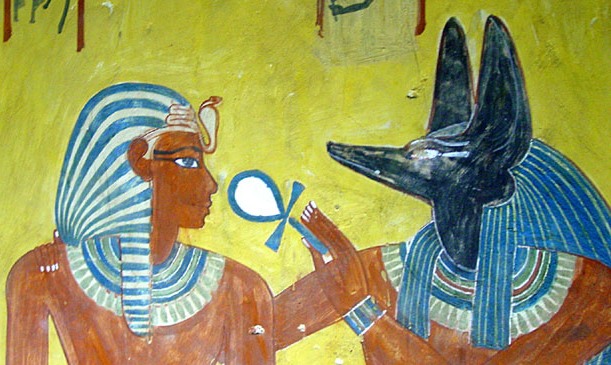 The ankh is one of the most widely recognized religious symbols in the world. Ask anyone what the ankh means, and invariably, the words, “eternal life” will be the definition that is offered even by laypersons.
In terms of the hieroglyphic catalogue or sign list that was put together by Sir Alan Gardiner, lists the ankh as Gardiner sign S 34. Scholars have speculated that it can either represent something as simple as a sandal strap, or as complex as an elaborate bow or knot that carried specific religious significance. The profusion if its use in iconography throughout Egyptian culture and that it is held by numerous ancient Egyptian deities in their various depictions underscores the meaning ascribed to the ankh – the meaning is life. Even those who could not read or wriite, and in Ancient Kemet, the literacy rate among its people was something like 2% or 3%, the meaning of the ankh was known. It was commonly found as a potter’s mark on vessels throughout the history of Egypt. (Shaw)
Even today, we often hear the ankh referred to as the Key of Life. More than this, it stands for several life-sustaining things. In some reliefs, ankhs are seen pouring out, to symbolize water and in turn purification. Other reliefs show the sustenance in the form of food or flower offerings which were referred to as ankhu. Most often, however, it is shown to represent the breath of life. Often statuary, paintings or reliefs will show a King, a Queen or other member of the noble class being presented with an ankh that is held beneath their nose by the god or goddess.

From the Tomb of Huya, Amarna Period, Courtesy of Wikimedia Commons

Mirror case from the tomb of Tutankhamun
The idea that a Temple was called a Per Ankh or ‘House of Life’ did not just mean simply it was a place of worship, but also learning how to live, via the Netjeru and that Rameses IV claimed that he had studied the papyri at the House of Life to learn the secrets of the gods. Living one’s life is an active thing and so we can only surmise that the training that the King underwent was experiential and the secrets he learned were not just intellectual in nature. (Naydler)
The ankh survives today, not just among Kemetics and Pagans who incorporate the symbol into their personal practices, but even after the fall of Ancient Egypt to Roman Rule and Roman Paganism, the natives of Egypt among the first to convert to Christianity, but the ankh survives in the form of the crux ansata, ansate, looped, or handle-shaped cross in the Coptic Church.
Resources
Naydler, Jeremy. Temple of the Cosmos: The Ancient Egyptian Experience of the Sacred. Rochester, VT: Inner Traditions, 1996. Print.
Naydler, Jeremy. Shamanic Wisdom in the Pyramid Texts: The Mystical Tradition of Ancient Egypt. Rochester, VT: Inner Traditions, 2005. Print.
Shaw, Ian, and Paul T. Nicholson. The Dictionary of Ancient Egypt. New York: Harry N. Abrams, 1995. Print.
Wilkinson, Richard H. Reading Egyptian Art: A Hieroglyphic Guide to Ancient Egyptian Painting and Sculpture., p.176 – 177; London: Thames and Hudson, 1992

Filed under kemetic, pagan, Pagan Blog Project 2014
Sekhem Talisman: Day 4 – 7
I shall not surrender me to any bad misfortune this year.
For I am Ra, who appears in his Eye!
I have arisen as Sekhmet, I have arisen as Wadjet.
For I am Atum behind his heads.
I am Atum who sojourns in the Two Lands
I am Sekhmet in the temple, the Lord of Mankind who made the gods, the Lord of Slaughtering who created respect for Ra.
For I am that Powerful One , lofty and high!
A portion of an amulet ritual, which comes from “Ancient Egyptian Magical Texts” by J.F. Borghouts, p. 13, E.J. Brill, 1978
These past few days we have been gripped by what meteorologists have termed a polar vortex. With windchill factors of more than 5-50 degrees below zero, it is easy to imagine why! This incredible cold has made it rather difficult to continue to work in the usual household shrine space simply because that part of the house is just so cold. I am working more in my bedroom now because it is currently the warmest room of the house.

The Sekhem amulet on the altar with The Chariot Card from the Voyager Tarot
One of the things I wanted to do with this rite is to connect to the numerology of this particular year overall, not just for my own personal birthdate. The focus is on overall sekhem and Ma’at and not just necessarily for me as an individual. There is a greater thought toward a collective goal that I am working on and I wanted to put that intent into my amulet as well.
If you take the Julian number of the year, 2014, it becomes a 7 when reduced in numerlogical terms. For me, that corresponds to the Chariot Card VII, in the Tarot. My personal favourite deck, and the one that I work with almost exclusively, is the Voyager Tarot, created by Dr. James Wanless as seen in my photograph.
The Seven and the Chariot have been rather appropriate for this exercise and this talisman in that seven comes up continually in Egyptian rtual and especially with Sekhmet. Sekhmet has Seven Arrows, which were often blamed for various illnesses or misfortunes sent by Her. Of course, this is not my focus for this project, it does bear some contemplation as to how the Seven Arrows tie in to illness, health and of course, Ma’at.
Personal Note:
Because I tend to be extremely private as far as my own personal religious and magical practices, this entire 30 Day Challenge has been a real stretch for me. Perhaps it comes back to the Kemetic ideal that other than State Rites, your religous, daily practices are your own and between you and the gods that you serve. No one can dicatate that; it has to come from within. there is a certain point that you reach in your life where religious devotion, magic, and focus become very much something that is personal and by necessity, it can be extremely private. 30 day challenges to stretch yourself and your focus are wonderful, however, I find myself asking if this would hold up to what we writers called the WIBBOW test: Wouldn’t I Be Better Off Writing? At this point, with a book nearing completion, I am beginning to lean toward, “Yes.”
Filed under 30 Day Talisman Challenge, pagan, sekhmet
Sekhem Talisman Day #3
My Sekhem pendant is about about the size of a set of dog tags; which makes it only slightly smaller than a license plate! Don’t get me wrong; I absolutely love it! Aidan made a beautiful piece that I wear daily, and happily so. It is the one that he made that I have posted pictures of in earlier entries rather than the one that I am working with for this 30 day challenge project. The current sekhem pendant is the second one that I have commissioned from a silversmith that was made to my own specifications.
The first pendant, by contrast, is very delicate and is a 3D miniature of the actual object rather than the glyph inside a cartouche.

Sekhem Pendant made by Michael Holland
This little dilemma between the two Sekhem’s actually got me to thinking about subtle power and not so subtle power and the comfort levels of each. Subtle power is not so noticible whereas, overt power tends to be out there and often get attention. As such, it can make the wielder of that more overt type of power at times feel a bit self-conscious about it. Learning how to deal with that difference can be a bit of a task. Sometimes, speaking from experience, being the less overt bit of power behind something has its advantages because there is great power, great sekhem in being underestimated. Either one has its place and it’s that which was my focus on this day.
Filed under 30 Day Talisman Challenge, kemetic, pagan, sekhmet
Sekhem Talisman – Day #2

Nefertari from her tomb in the Valley of the Queens, Egypt
The daily rite was performed with the usual purifications and invocations. Because I had an intensely busy day, after the purifications and invocations, I began to set the focus on being what Sekhem means. I spent most of the day meditating on this idea and what the symbol and the actual concept means for me as an individual in my own life and what it means on a larger, global scale. There are far too many ways in which power, both personal and on a larger scale is misused. With power or sekhem comes a great deal of responsibility. Each choice we make, each action we choose has within it the idea of sekhem. Those of us who are Kemetic often know that the cornerstone, indeed the foundation of all of this is the idea of ma’at.
Perhaps the largest focus for me is overcoming the element of fear. That may be something that one would believe that a daughter of Sekhmet would not have but I can assure you, at times we do; just like everyone else!During the meditation it became quite apparent to me that even a seeming weakness, however, can ultimately lead to strength in that area or another one that compensates. Sometimes fear can be a phantom and what is perceived is not real at all. The power or the sekhem in this is knowing what is real, or what is Ma’at and not. Since Sekhmet, the personification of what Sekhem actually is, upholds Ma’at or rightness – order, it seemed more than a little appropriate that differentiation and discernment would be a part of that process.
Later today I will post for Day 3 of the rites in this challenge.
Filed under 30 Day Talisman Challenge, kemetic, mystic woo-woo, pagan, sekhmet
30 Day Talisman Challenge – Sekhem Talisman – Day 1
Since my practices are Kemetic (Ancient Egyptian), we tend to do our rituals a little differently. I decided to actually start the consecration of the amulet today, as the year turns from 2013 to 2014 and when the Moon is New. For this specific ritual as I do most times, I am working with Sekhmet, who is my Spiritual Mother, and also the God Amun.
My entry into the 30 Day Talisman Challenge is working with a pendant that I did not create, but rather worked with jewelry smith and magician, Aidan Watcher. I helped design the piece and my friend who is an extraordinary craftsman made the pendant is of solid silver. The symbol at the centre of the cartouche is Gardiner Sign S42 and represents a baton or scepter that was in use since the Third Dynasty in Egypt known as the Sekhem. Sekhem is the root word for the Goddess Sekhmet, which literally means ‘Power’ or ‘Might’. Sekhmet is known as ‘She of Might’ or ‘The Powerful One’.
The first part of the ritual consecration begins as all Kemetic rituals do – first with purification of the body and of the mouth with water and natron so that the words of power or heka when spoken are also true coming from a mouth and a person who has been suitably and ritually purified. Then is added light, incense and sound.
Each day that I do the rite, there will be heka spoken over the Sekhem pendant will underscore the authority that it as a symbol confers. The amulet is worn during that day, meditating on each point during the course of the day, At night the amulet is removed and left in the shrine with icons of the Goddess Sekhmet, an icon of the God Amun, and a third icon of the Goddess Ma’at. Each have specific significance to the rite and are instrumental in the consecration rites. A 7 day candle burns before the shrine at night, while during the day wen the amulet is worn and the sun is shining, the shrine doors are closed.
Filed under 30 Day Talisman Challenge, kemetic, mystic woo-woo, pagan
Questions for Tess Dawson
Mine was one of the comments that were censored by Ms. Dawson. This, however, really does not matter in that I have a habit of keeping record of absolutely everything I post, including commentary on blogs, on Facebook, etc. This is a very good habit to get into, btw.
Ms. Dawson, et al will note that none of the questions posed by Grim’s Wolf have been adequately answered. While some may feel that she is, “0ne of us”. I however, adamantly and resoundingly disagree with that sentiment. Disingenuousness is never appreciated in any context at any time. Being somewhat of a celebrity in the Pagan / Reconstructionist etc. communities also does not give one a “pass”.

Filed under Uncategorized

 Fanny Fae